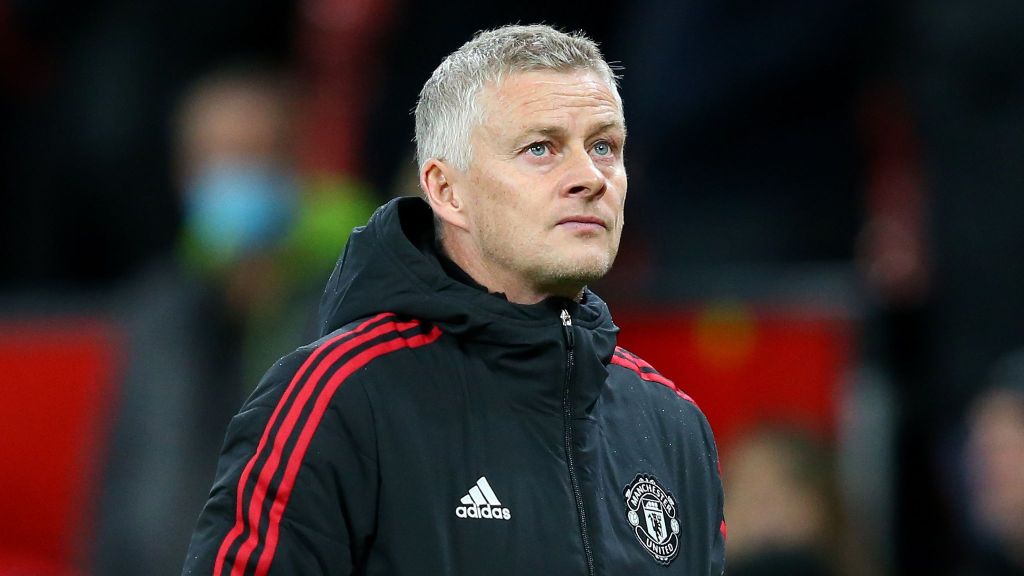
It had been coming, that much was plain to see. When the irrepressible Mo Salah put away his third – and Liverpool’s 5th – of the afternoon on Sunday, there were scenes of jubilation in the Liverpool end – catharsis for a big win at Old Trafford which, despite United’s struggles in the post-Ferguson era, haven’t been too easy to come by. For the United fans in attendance and watching around the globe, there was a sense of shell shock, but also resignation. Was anyone really that surprised? A thumping at home against Liverpool is about as painful a thumping as United can get, but it was a long time in the making.
It’s tough to believe that only 13 games have passed since Solskjaer had guided this team to a 2nd place finish in the league and was gearing up for a trip to Gdansk for his crowning moment – a major European final with United against Villarreal. Sure, it wasn’t the Champions League, but at that time, it didn’t have to be. External observers pointed to warning signs around the team – an overreliance on Bruno Fernandes, a lack of tactical nous in the big games where Solskjaer’s mid-game adjustments were as likely to lose United a game than win it, and some lopsided defeats along the way.
To the majority of United fans, this was all background noise. To focus too much on what wasn’t yet there in the squad was to ignore where the squad had come from and the progress it had made. Much has been made of what the expectations are and should be of a United manager in the past 8 years, and the observations usually fail to take into account that the revised expectation is quite simple – progress. Ole has never been ‘expected to deliver a major trophy’ in any given season – at least, not up until this point. The next manager won’t be ‘expected’ to do so either. The simple fact is this, and it applies equally to City, Liverpool and Chelsea as much as United – up against some of the best managers of this generation domestically, not to mention in Europe, and some of the best squads ever assembled, no team has a divine right to win a league or a European trophy, and failure to do in any given season is not and should not be a sackable offence for any of the top managers.
The devil, then, is in the detail. If you’re one of the so-called ‘Big Six’ and you win the league, great. If you don’t, you get the magnifying glass out and examine the season on its merits. Normally, a manager will survive as long as the team is ‘moving in the right direction’, as vague a concept as that is. Klopp and Guardiola demonstrated this despite taking time to reach the summit of the league. While Solskjaer does not have anywhere near the managerial pedigree behind him as those two, he did have credit in the bank as a club legend, took over with what appeared to be a Midas touch for his first three months, has genuinely progressed the team to be a much better outfit than the one he took over, and up until United made the trip to Poland in May, looked to have the team on an upward trajectory, improving year on year despite the obvious concerns. This kept him in a job, and for these reasons at least, he should be recognised and credited for doing valuable work.
Considering the freefall United have entered into since Gdansk, it is ironic that the decisive penalty on Europa League final night was scored by a man called Géronimo. That match feels like a sliding doors moment at this stage. United looked to be much the better team against an extremely defensive Villarreal team. And then they were out-thought. Unai Emery’s substitutions changed the game to the point where United were hanging on. And still Solskjaer was paralysed, unable to make a change. Marcus Rashford (in fairness to him, injured) put in a display that lives on in infamy and was kept on the pitch. Eventually United got what they deserved. It was also Villarreal, at Old Trafford this year, that telegraphed what was to come in the Liverpool game. That 5-0 could and probably should have been theirs. Arnaut Danjuma will be gutted that he likely won’t get another run at Dalot in the return fixture. In reality, other than the Leeds game where Bielsa offered up the definition of insanity at Old Trafford once again, and the Newcastle game with Steve Bruce already a dead man walking this year, United could conceivably have lost every other game. They have never once looked in control in any game other than those two.
Why has this happened? How did it go wrong so quickly? There are a number of reasons. First, this United team brought back the ‘feel good factor’; that great intangible that was credited to Solskjaer. The flip side of that is that the team thrives and survives on feeling. It is mentally fragile, capable of looking like world beaters with their tails up but with those tails put firmly between their legs at the first sign of things going wrong. Solskjaer’s fallibility being shown up so starkly against Villarreal has appeared to be a major shock to the system, and served to highlight the limitations of United’s counterattack, give-it-to-Bruno approach.
Secondly, Solskjaer’s attempts to correct the course of the ship in the wake of witnessing this have been nothing short of disastrous. It’s funny that one of his potential successors in the job could sum up United’s problems the most succinctly – as Zinedine Zidane said when Beckham was bought for Real Madrid while they lost Claude Makelélé: “Why put another layer of gold paint on the Bentley when you are losing the entire engine?” United can’t control games because they have no engine room. The ‘McFred’ partnership is Solskjaer’s safety blanket – and it doesn’t work whatsoever. McTominay on his own is a good player capable of being one of the workers in a squad such as United’s – a useful box to box player. Fred is nowhere near good enough. Nemanja Matic’s legs have gone. Pogba is disinterested. Donny van de Beek – well, only Solskjaer seems to see the logic in not giving him a chance.
Despite all of this, United did not address this glaring hole in the summer, and went about devising an updated 4-2-3-1 system that would have them dominate games rather than sit waiting on the counter. This has been ruthlessly exposed by Liverpool and Leicester in the space of a week, and it could have been a lot worse. The issues here affect the whole team. What is on paper a decent defence now looks woefully exposed. What is on paper a world class attack is isolated, crowded out, and has too many mouths to feed. When the midfield leaks like a sieve, there are very few (if any) teams you can go out and beat comfortably. When teams can pass so easily between your lines and see how frequently you cough up chances as a result, they know you can be got at, and they have nothing to fear from you, regardless of who is lining up in your attack. The fact that Solskjaer and Murtough knew this in the summer and decided to go for Ronaldo and call it a day was misguided. The fact Solskjaer then decided to crack on and set the team up as though he had actually addressed that problem was lunacy, and has probably cost him his job.
Solskjaer has always looked most comfortable in his managerial tenure on the back foot, both literally and metaphorically. When United can draw teams in and break at speed, they sucker punch them. Solskjaer has outwitted Pep Guardiola multiple times doing this, among others, and had one of the best records in the big games doing this. Similarly, when Solskjaer is personally on the back foot, facing calls for his head and the noise becomes a crescendo, he usually pulls something out of the bag. The second half against Atalanta showed this most recently, and showed how much the players like him and how much players and fans want this to work out, but it is a recurring theme. This counterpunching style of play was always going to suit the United he inherited post-Mourinho, but it was widely understood that in order to take the leap to the next level, this United team would have to go out and dominate games. Solskjaer has not shown he can do this with this United team. In trying to do so without the personnel in the middle to enable him to do so, it is tough to escape the feeling that he has sucker punched himself.
It is difficult to know where United go from here. There is staggering potential in this squad – Rashford, Greenwood, Sancho, Varane, Fernandes and Shaw are top talents with the ability to improve further. There is a crop of extremely exciting youth players behind them coming through. The team (with the exception of midfield) is blessed with players that would be the envy of most clubs. Problems remain – there has been deadwood at the club for so long that it is biodegrading by this point. The attack is going to have some unhappy players in it because there are only so many minutes going. The team lacks belief that they can be one of the top teams. Enough column inches have been devoted to Paul Pogba that it almost feels redundant going over it here again, but he remains a puzzle that may be impossible to solve. There have been fears that the team is essentially ‘unmanageable’ and that it is impossible to keep both the playing squad and the owners happy.
A new manager will have to contend with all of this. It is imperative that United get this next appointment right. Ole at the wheel may well have run out of petrol by this point, but he was at least going in the right direction with the squad, which has undoubtedly progressed. A Mourinho-esque ‘quick fix’ will fix nothing and will undo that work. Ole has stalled the car at a crossroads for United. Picking which way to go next could define the club for the next few years, for better or worse.
 Adjudged Offside